
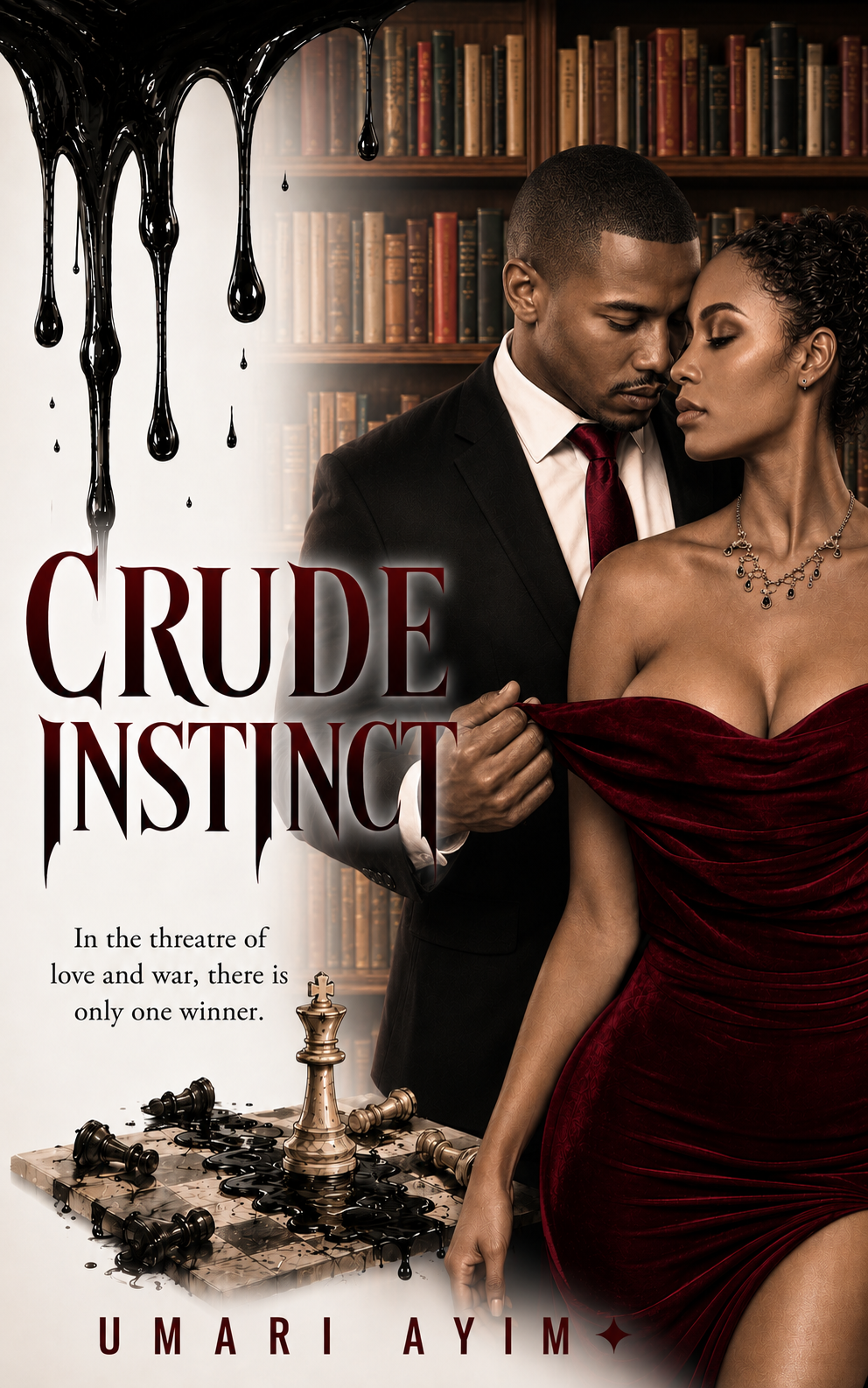
CRUDE INSTINCT (12)
The Check and WhatsApp Confessions
Marine Beach
Apapa, Lagos
1:17 am
Timothy lay flat on his back on the narrow mattress, eyes fixed on the slightly rusty ceiling fan turning above him in slow, uneven circles. The blades clicked faintly at every rotation, a small mechanical protest against the humidity that clung to the room.
Outside, the port district breathed in the distant clank of containers, roar of passing vehicles and a dog that barked once before falling into silence. The single bulb had been switched off hours earlier, leaving only the thin amber bleed of a streetlight through the curtain to reach him. He had been trying to sleep, but instead his mind kept returning to his encounter with the police two nights earlier.
They had been three in the car, the windows cracked against the heat, heading toward Obalende for cold drinks at a friend’s place. The beams from the torchlights in the hands of the policemen at the checkpoint appeared without warning, cutting across the windscreen in hard white bars.
One policeman approached with an unhurried gait. He walked the length of the vehicle, peering at the men inside it. When his light reached Timothy’s face it lingered. Timothy had done his best to meet the stare.
The policeman’s eyes narrowed slightly. He stepped back and murmured to his colleague. The second officer straightened. His eyes still on them, his face began drifting toward the radio in his hand.
Timothy felt his chest tighten. He spoke low and fast, the words coming out in breathless gasps.
“Guy, move! Move, move, move!”
His friend hesitated only long enough to swear under his breath, then stamped the accelerator. The car shot forward. Behind them the torch beams swung wildly, slicing the dark. For three full seconds, Timothy waited for the sharp, flat crack of gunfire against the rear window. He imagined the glass starring, the sudden heat between his shoulder blades. None came. The only sound that filled his ears was the thud thud thud of his wildly beating heart.
They drove without lights for several streets, the engine too loud, every pair of headlights behind them a possible pursuit. Only when the road opened and the checkpoint had been swallowed by distance did anyone speak again, and even then the words were thin, almost embarrassed, as if they had all agreed not to name what had nearly happened.
He had told himself then that it was ordinary checkpoint aggression. Yet lying on the bed that morning, he no longer believed that.
He sat up. The mattress protested. He reached beneath the hard, lumpy pillow, withdrew the ziplock bag, and sat with it open across his knees. Only now, with the memory of the torchlight still sharp behind his eyes, did he allow himself to unfold the six sheets properly.
The paper was heavier than it looked. It held no signature block, only a reference number, a date, and vague terminology. He read what he understood quietly.
“Disruptive intervention.”
“Temporary degradation of production capacity.”
“Plausible external attribution.”
The Igbokoda asset from which he and the others had been drawing crude oil was named once. Coordinates followed. An operational window. Recommended method. Expected downtime. Suggested narrative should anyone come asking questions later.
Halfway down the second page a handwritten annotation appeared in the margin. The ink was a shade darker than the printed text. He read it inwardly.
Asset currently under primary operational control of Oleo Energy. Confirm ownership chain before final authorisation.
Timothy’s thumb stopped.
Oleo Energy.
He turned the remaining pages, highlighting payment routes through intermediaries and other maritime trading terminology that sounded like a foreign language. On the final sheet, near the bottom, a short directive was in the same darker ink.
All operational risk to be absorbed at field level. Originating authority remains insulated. Report only through designated channel.
Timothy set the pages aside and considered what he was about to do. He feared an unfavourable outcome, but greed was persuasive, and survival had a way of making unlikely bargains seem necessary.
He would go to Abuja and find his way to the company whose asset they had stolen from. Lagos had become a risky bargain. Every additional hour increased the chance that the next policeman would not merely stare.
He rose and crossed to the small bag he had kept packed since the night he arrived. Inside were a low cap, cheap reading glasses and nondescript clothing. Nothing theatrical, only enough to buy a second or two of uncertainty. He would change the way he walked, the set of his shoulders. He had done it before.
He refolded the six sheets into their original thin rectangle, pressed the air from the ziplock until the plastic lay flat against the paper, then slipped it into the inner pocket of his bag.
He had jumped from a barge once already. This time the water was made of asphalt and checkpoints and men who had been told what his face was worth. The principle, however, remained unchanged.
Move before the light finds you.
***********************
NAF Conference
Centre & Suites
Kado District, Abuja
10:17 a.m.
The boardroom held an air of carefully restrained anticipation. The air conditioning hummed too loudly. The water carafes remained untouched. Seven shareholders sat in a configuration that left the head of the table conspicuously empty.
Mina arrived last. She took the seat two places down from Danjuma, her expression composed, her folder already open to the page she would not need to read. She had expected the absence. The entire point of the morning was the absence.
Under Article 19.4 of Oleo Energy’s Articles of Association, any three shareholders holding, in aggregate, not less than fifteen per cent of the issued ordinary shares could requisition an extraordinary general meeting on not less than forty eight hours’ notice when the requisitioners certified, in writing, that an operational crisis existed capable of materially affecting the company’s going concern status.
The Igbokoda asset had supplied the crisis. The consecutive operational reports showing the stalled progress had been enough. The notices had gone out before midnight. Obinna’s office had been copied as a courtesy required by the articles. Courtesy, not consent.
Danjuma opened the meeting without ceremony.
“We are quorate under the articles. The Chairman has been duly notified and has chosen not to attend. We proceed.”
No one objected. The faces around the table were careful. Two older shareholders from the original consortium sat with their pens already uncapped. A younger woman who controlled a family trust kept her eyes on the polished surface of the table. At the far end sat Ibrahim Sule, a soft spoken investor who had taken a modest but strategically placed stake three years earlier. Mina had spoken with him twice in the past ten days. He had listened and not disagreed. She had counted him as an ally. She nodded solemnly at the room and began.
“The Igbokoda asset is no longer performing to the model that underpinned the last valuation. The operational frustrations are documented. Capital is being absorbed without corresponding returns. At the same time, the company’s leadership continues to make decisions on banking facilities and offtake strategy without adequate consultation of the board. The articles allow us to consider a resolution for change in the office of Chairman and Managing Director when the interests of the company require it. I propose we place that resolution on the floor.”
Danjuma seconded immediately. Two others nodded. The motion was live.
For twenty minutes the conversation moved with the practised urgency of people who believed the outcome was already arranged. Criticisms of the Igbokoda delays were rehearsed. Questions were asked about the timing of certain banking covenants. Someone mentioned the need for “fresh direction.” Mina kept her interventions short and precise. She did not overplay her hand. She did not need to. The room was leaning.
Then Ibrahim Sule cleared his throat. He did not raise his voice. He simply placed a thin folder on the table and slid it forward until it rested in the centre of the polished wood.
“Before we vote,” he said, “I think the table should see this.”
The folder contained three documents. The first was a set of irrevocable proxy forms, dated two days earlier and already lodged with the company secretary, representing an additional 11.4 per cent of the issued shares. The proxies were given in favour of the existing Chairman on all resolutions concerning the composition of the board or the office of Managing Director until the next scheduled annual general meeting.
The second document was a short legal opinion, on the letterhead of a firm none of them used regularly, confirming that the proxies were valid under Article 27 and could not be revoked once lodged except by written notice from the grantors themselves.
The third was a single page extract from the company’s register of members showing that the proxies, when added to the shares already aligned with Obinna, produced a blocking minority on any ordinary resolution and a decisive weight against any special resolution requiring seventy five per cent.
Silence settled over the table with the weight of something irreversible.
Ibrahim continued in the same mild tone.
“When I was approached, I listened because of my regard for those present, but I am here on behalf of the Chairman. He asked me to convey that the operational difficulties at Igbokoda are being addressed through channels that do not require a change in leadership, and that any attempt to force such a change on short notice, while those channels are active, will be treated as an attempt to exploit a temporary vulnerability rather than to protect the company.”
Danjuma’s pen had stopped moving. The woman from the family trust sat very still. Mina felt the heat rise under her collar and forced her face to remain neutral.
Ibrahim looked directly at her for the first time.
“Under the articles, this meeting remains valid. The resolution, however, cannot pass. The proxies are already counted. Any vote taken now will simply confirm that fact for the record.”
No one moved to call the vote. The requisition that had seemed so carefully constructed two days earlier now sat on the table like an exhibit in someone else’s case.
Mina kept her voice level.
“The operational problems at Igbokoda are real.”
“They are,” Sule agreed. “The Chairman is aware of this fact. He is addressing it.”
He gathered the folder, stood, and inclined his head to the room.
“I believe we are finished here.”
The meeting dissolved without formal adjournment. Chairs scraped. Papers were collected in silence. Danjuma did not look at Mina as he left. The others followed in ones and twos until only she remained, the empty head of the table facing her like an accusation.
She sat for a full minute after the last door closed. Finally she closed her folder and rose, smoothing out the front of her dress with care. When she walked out, she went with the valiant effort of a person still in denial of defeat, carrying herself with the composure of someone who had not just watched her carefully constructed plans collapse in front of her.
**********************
Oleo Energy Headquarters
Central Business District,
Abuja
11:03 a.m.
The office still carried the faint, expensive scent of jet fuel and alpine cold that had arrived with Sameer forty minutes earlier. His carry on stood untouched beside the low sofa. A half-finished espresso sat cooling on the side table, the crema already broken. Sameer himself stood at the wide window with his back to the room, phone pressed to his ear, the soft consonants of Levantine Arabic moving quickly across the glass.
“Khalas, khayi. Rah koun fi Beirut ba‘d usbu‘ayn. Wa‘dak. Ma tkhaf.”
He listened for a moment longer, the line of his shoulders easing almost imperceptibly, then ended the call and slipped the phone into the pocket of his charcoal trousers. When he turned, the residual tension of the long flight from Zurich still sat behind his eyes, but the smile he offered Obinna was genuine.
Obinna barely registered it. He sat angled toward the dual monitors on his desk, one displaying cascading operational data, the other open to a Microsoft Teams window. The newly established London office appeared in crisp high definition with three of Oleo’s brand new representatives seated around a pale oak table in a glass walled meeting room overlooking the Thames, the morning light over Canary Wharf clean and hard.
Their voices came through the speakers at a low, professional volume as they discussed offtake structuring, the timing of the first cargo nominations and the quiet pressure already building from two European trading houses.
Obinna’s fingers rested lightly on the trackpad, occasionally adjusting the shared screen or typing a single, precise note into the chat. He had not spoken in twelve minutes. He did not need to. The room in London understood that his silence was attention, not absence.
Sameer crossed to the chair opposite the desk and settled into it without interrupting. He had learned long ago that Obinna’s concentration, once locked, was best left undisturbed until it released itself.
The Teams meeting continued. One of the London representatives leaned forward, outlining a contingency on pricing differentials. Obinna’s eyes narrowed a fraction, the only sign that a point had registered. Outside the office windows the Abuja skyline shimmered under late morning heat, the harmattan haze already beginning to soften the edges of distant tower cranes.
Obinna’s phone, lying beside the keyboard, vibrated once. He glanced at the screen, accepted the call, and raised it to his ear without turning away from the monitors.
“Ibrahim.”
The voice on the other end was low and measured. The report took less than forty seconds. Obinna listened without interruption, the only movement a slow flex of the fingers of his free hand against the desk. When the call ended he set the phone down with deliberate care.
A satisfied smile touched the corner of his mouth. Sameer watched him for a moment, reading the residual calm in the set of his shoulders.
“All went according to plan?” he asked.
Obinna’s eyes drifted away from the monitors to him.
“Yes.”
“And Badejo?”
“Triggered the greedy bastard’s release clause. He is my bitch again.”
Sameer gave a short, admiring breath of laughter.
“Wallah, you are too good at this.”
***********************
Guzape Hills
3 pm
The light in the living room upstairs was low, deliberately so. A single lamp threw a warm circle across the polished floor while the rest of the room remained in shadow. The air held the quiet scent of leather and the fainter, medicinal trace that still clung to a man only hours out of hospital.
The Minister of Petroleum, Yinka Badejo, occupied one of the deep armchairs, posture carefully composed, the fresh dressing on his forearm hidden beneath a crisp shirt cuff. He watched the two other men without speaking.
The magnate stood near the window, one hand resting on the back of a chair, his back half turned to the room. When he finally spoke, the voice was soft, almost conversational, yet it carried the unmistakable hint of patience wearing thin.
“So you are saying there is still no word from the young man?”
The Inspector General remained standing, shoulders squared in the old parade ground manner.
“Yes sir. We have every checkpoint active from Edo to Cross River, sir. The creeks, the jetties, the known safe houses. Nothing has surfaced.”
The magnate turned fully now. The fading light caught the hard planes of his face.
“Checkpoints. Every time, checkpoints. Is that all you have after all this time?”
He took a slow step closer.
“Do you understand what it means when a man vanishes with knowledge he was never meant to keep? Or have you become so used to failure that you can’t see how dangerous this is?”
The Inspector General’s mouth opened, then closed again.
“Sir, I will widen the net…”
“You will do more than that.” The magnate’s voice remained quiet, but the temperature in the room had dropped. “You will find him. Or you will discover that my tolerance for your disgraceful incompetence has limits.” He held the other man’s gaze a moment longer, then flicked his fingers toward the door. “Get out.”
The Inspector General inclined his head once, the gesture tight with restrained humiliation, and left. The soft click of the door closing seemed louder than it should have been.
Silence settled. The magnate remained where he stood, jaw set, eyes still fixed on the place the policeman had occupied. Only after a full minute did he turn to Badejo.
His regard was cool, almost clinical, the look of a man recalculating the board after several pieces had been lost.
“The move with the board failed,” he said at last, the admission edged with private fury. “That young man pulled a fast one and held every line we tried to break.”
He studied Badejo in the low light.
“It appears you are my only remaining hope.”
For a moment the petroleum minister did not move. Then the corner of his mouth lifted in a slow, deliberate smile.
“Don’t worry sir,” he answered, voice smooth, “I won’t disappoint you.”
***********************
River Kubani Crescent
Maitama, Abuja
8 pm
It had been three days. She had not left. Each morning, before the sky above Maitama had fully lightened, he had written her a few lines on the pale card stock he kept in the top drawer of the desk downstairs. Each note had carried his wishes for her continued presence.
Stay as long as you need. The house is quieter with you in it.
Don’t rush back home. Take your time.
We can play a game later when I am back.
She had answered by remaining. First one day, then the next, the sheets clean but still warm when he returned at night, the air in the room carrying the faint citrus of her skin.
Tonight the gates parted for him in silence. He parked beneath the portico and sat a moment longer than necessary, the engine ticking as it cooled, before stepping into the house.
Upstairs the primary suite was half in shadow. The only light came from the bathroom, a soft amber spill across the threshold. Water ran steadily behind the half open door, the steam drifting in slow, lazy ribbons that carried the clean scent of her soap.
He shrugged out of his jacket and let it fall across the foot of the bed. As he turned, the glow of a phone still alive and lying near the edge of the mattress caught his attention. He meant to look away. Instead his hand closed around it.
The open chat was titled Sisterz and Secrets. Rachel’s most recent message sat alone at the bottom of the thread, sent only minutes earlier.
Ladies, question. Have you ever loved someone that sometimes you wished you could just crawl into them and stay there forever?
Obinna stood very still.
The words seemed to alter the temperature of the room. He felt them settle behind his ribs. For a fraction of a second, the careful arrangement of his face loosened. His eyebrows drew together, his eyes darkened, and the muscle at the corner of his mouth tightened. He looked toward the bathroom.
Through the steam he could see the blurred shape of her body moving under the water. She had begun to hum, a low, private melody that rose and fell with no particular tune, the sound of someone who believed herself completely alone.
His gaze returned to the phone. The message remained. He set the device back exactly where he had found it, screen still glowing against the white linen, and left the room without a sound.
The corridor was darker. He walked the short distance to his study, closed the door, and stood for a long time in the unlit space, the shape of the words he had found still turning slowly in his mind’s eye.
********************
Obinna’s Study
8:30 pm
The new study held its usual quiet, the kind Obinna cultivated deliberately. It was a room designed to be insulated from the interruptions of the household. His private stronghold where decisions were made, alliances examined and inconvenient truths reduced to matters of strategy.
The desk lamp cast a concentrated pool of light across his papers, leaving the bookshelves and the far corners of the room in shadow as he worked silently.
Rachel paused in the doorway, the hem of her dress still brushing the tops of her thighs. The fabric was a simple sleeveless print, cotton softened by many washings, the pattern a scatter of indigo and cream that seemed to shift with every breath.
She carried the citrus and sandalwood scent of the spa’s oils into the room with her, a bright, living contrast to the study’s cooler stillness.
She smiled as she crossed the threshold.
“I saw your jacket on the bed and didn’t see you anywhere,” she said, the words light, almost teasing. “Almost as if you vanished. Couldn’t you have waited five more minutes?”
Obinna looked up and fixed his eyes on her with a concentration so complete it felt almost physical, as though the air between them had thickened. The lamp carved the planes of his face into something both familiar and newly severe – the clean line of the jaw, the controlled set of the mouth, the dark, reflective depth of his gaze.
He watched her contemplatively, with a stillness that was not indifference but something far more deliberate.
Rachel felt the weight of that regard settle against her skin. She came around the edge of the desk, the soft slap of her bare feet muted on the rug, and leaned her hips against the polished wood so that she faced him fully.
The movement brought her into the circle of light. It found the gleam on her collarbones, the subtle sheen along her arms, the way the dress clung lightly to the damp curve of her waist. His eyes moved once, slowly, over that luminous skin.
“You look radiant.”
“It was my spa day today. I went after work.”
“Have you eaten?” he asked.
“No.” She let her fingers rest lightly on the edge of the desk. “I was waiting for you.”
“I need to finish one email.” His voice remained even, measured. “I will be with you shortly.”
The dismissal was gentle, almost regretful, yet it carried the unmistakable shape of a boundary. Rachel nodded, straightened, and as she turned to leave she laid her palm against the centre of his chest in a light gesture of farewell.
Before she could withdraw, his hand closed over hers. The contact was warm, firm, decisive. He drew her forward in one fluid motion until the edge of the desk pressed into the backs of her thighs and her body tilted into the space above his. The kiss that followed was lingering, unhurried, dense with a quiet intensity that asked no permission and offered no explanation. It tasted of the evening’s restraint and something deeper, something that had been turning behind his eyes since the moment she entered the room.
His mouth moved against hers with careful thoroughness, as though he were committing the shape of her to memory even while he held himself elsewhere.
When he finally released her, Rachel’s breath came short and uneven. She remained suspended for a moment in the narrow space between his chair and the desk, pulse loud in her ears.
Obinna’s eyes held the same reflective distance, as though the kiss had been both a concession and a withholding.
“Be with you soon,” he said.
She stepped back. The floor felt less steady than it had a moment before. She managed another smile, and left the study without trusting herself to speak again.
The corridor stretched ahead of her, dim and suddenly longer. Behind her the soft click of the laptop keys resumed, measured and unhurried.
She walked downstairs toward the kitchen with the taste of him still on her lips and the quiet, bewildering sense that something essential had shifted in the room she had just left.
© Umari Ayim.
2026