
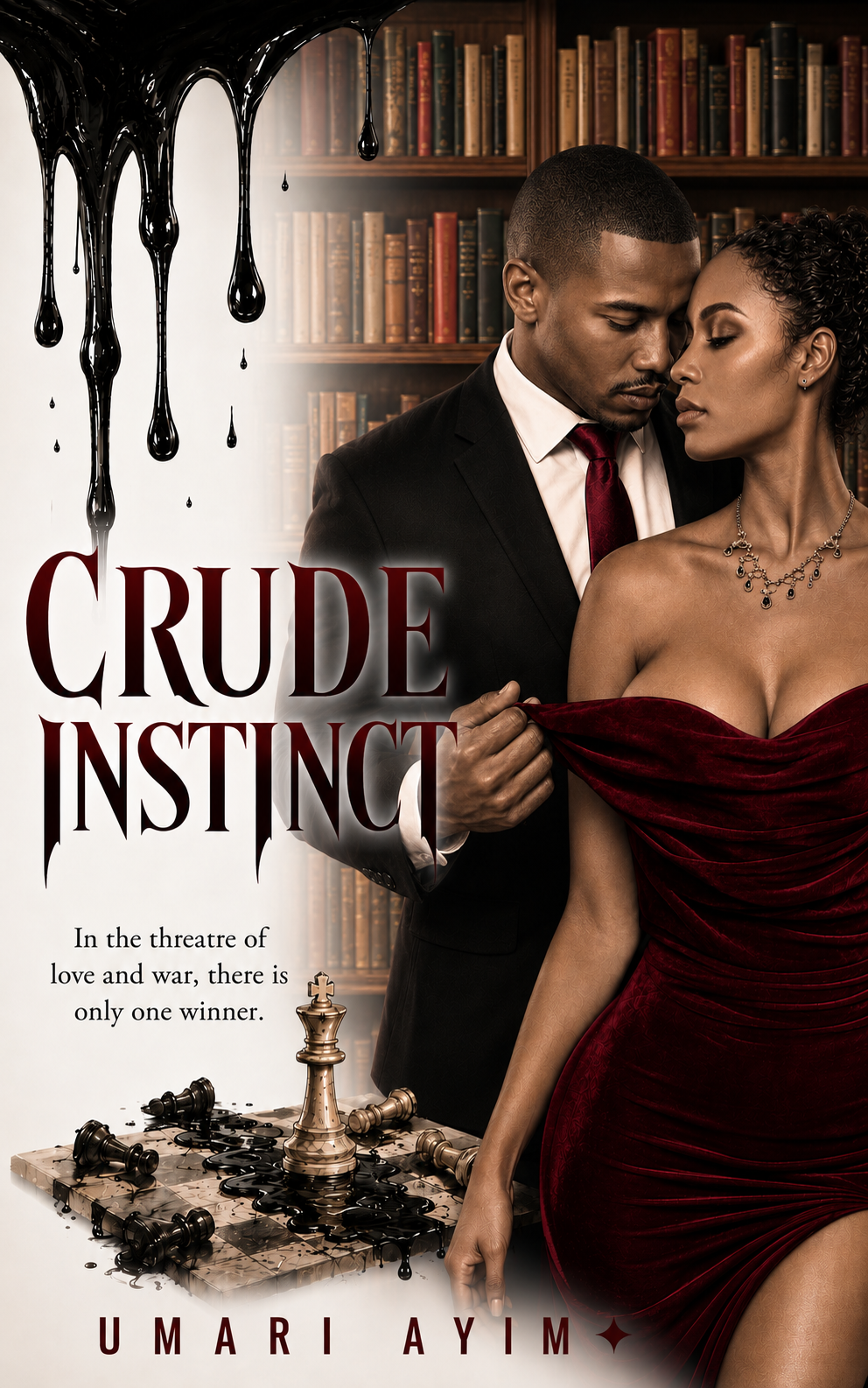
CRUDE INSTINCT (9)
Cheer, Tears and Abuja Nights
Fraser Suites
2:17 a.m.
Obinna sat alone in his suite. A single lamp threw a hard circle of light across three open laptops and a cascade of printed diagrams that Keller had couriered from Zurich under diplomatic cover.
Sameer’s channel blinked once. Then Keller’s face appeared, silver hair perfectly ordered even at this hour, the folder from the earlier call now replaced by a thicker one.
“We have him,” Keller said. No preamble. “The foundation’s fiduciary records were meant to end in Liechtenstein. They do not. A single administrative error, an old power of attorney never revoked, opened a side door into a Cayman holding company called Apex Holdings. From there the path is no longer opaque.”
Keller paused to catch his breath and then continued, voice as dry as the paper he turned.
“Apex is controlled by two men sitting beside your magnate. The first is Viktor Raskolnikov, former arms intermediary, blacklisted by OFAC after the 2019 Sudan contracts. The second is Charles Ellison, previously a director at Chevron U.S., convicted in federal court of securities fraud and insider trading. He served thirty one months. Both men appear on the beneficial ownership schedule of the Luxembourg vehicle that is building the position against Oleo.”
Obinna’s eyes moved across the documents as they arrived on his screen. Corporate filings, wire trails, a grainy photograph of the three men leaving a Geneva hotel together six weeks earlier. The magnate in the center, a soft, confident smile on his face.
“The pattern is complete,” Keller said. “The approach is not a rescue. It is a controlled strangulation designed by men who have already been stripped of respectable capital. They need Oleo clean. They need it desperate.”
Obinna closed the final file with a quiet click.
“Then we will give them something else to clean.”
He reached for the clean phone and dialed the number that connected directly to Ofer. The conversation was brief, measured and precise. When it ended, Obinna set the phone down and returned to the window.
**********************
03° 07′ N, 08° 21′ E
Offshore Nigerian waters
4 am
The sea had been quiet for so long that the men had begun to mistake quiet for safety. They had made the stop at Port Harcourt, picking two men for the day’s round. The boss had delivered the coordinates and the other vessel was making its way to the agreed stop.
Their barge moved heavily through the darkness, its belly deep with stolen crude, its engines beating a slow, dependable rhythm beneath their feet.
There was no moon. Nothing marked the horizon except the occasional distant pinprick of a vessel and the faint, oily sheen of reflected light across the water.
They were well offshore now, closer to Equatorial Guinea than to the creeks from which they had come. The scout stood alone at the bow. He had been there for nearly an hour, smoking a cigarette down to the filter, watching the blackness ahead.
Then he saw a light. He frowned. It disappeared. He waited. The light appeared again.
This time there were two. He threw the cigarette into the sea and reached for the binoculars hanging against his chest. He looked. His expression changed. He called to one of the men behind him.
“Timo?”
The man looked up.
“Wetin?”
The scout did not answer immediately. He raised the binoculars again.
The vessel had come into clearer view, cutting through the darkness with the slow, deliberate certainty of something that had no reason to hurry.
Grey hull. Military profile. The scout’s mouth went dry.
“No be navy be dat?”
The word came almost as a whisper.
The others stared at him. Nobody moved. Then the scout turned sharply.
“Up Wine! Water boys dey show this side!”
The words struck the deck like a thrown stone.
“Ahoy dey come!”
Everything changed at once. A man near the engine rose so quickly he nearly fell.
“Call Chairman!”
The helmsman reached for his phone.
“Network no dey!”
“Try am again!”
He lifted the phone toward the sky, turning in a desperate circle. The naval vessel continued toward them. It was still too far away for them to make out the men aboard, but there was no mistaking its purpose now. It was not passing. It was bearing directly toward them.
A faint beam swept across the water and disappeared. Then came another.
The men watched it move over the surface.
Closer.
Closer.
The helmsman grabbed the radio.
“Chairman! Chairman!” he called into the handset, though he knew no one was listening. “Chairman, you dey hear me?”
Static answered.
He struck the radio with the heel of his palm.
“Leave that one!” the scout shouted.
“Everybody move!”
Visions of dark cells and windowless rooms flashed through the half-dozen minds scattered around the boat. Adrenaline hit frozen legs. The deck erupted.
One man tried to grab his shoes, another shoved him out of the way.
“Abobi run!”
They dispersed like ants before a descending boot. They grabbed the smaller escape boat, then began cutting loose the ropes. A meticulous one pulled open a locker and started throwing phones and documents into the water. His mate gestured wildly in his face.
“Leave am! Leave am! Leave everything!”
One by one, they went over the side, dropping silently into the black water which swallowed them without a sound.
Behind them, the barge continued forward, engine still running, deck lights burning softly over the abandoned cargo.
For one strange moment it looked almost peaceful. Then the naval vessel’s searchlight came alive.
A white blade swept across the darkness and caught the barge full in the side.
The men in the water had already scattered, each using their knowledge of the terrain to reach the shore.
Nobody called for Chairman again. Nobody called anybody.
They just swam.
*****************************
Washington, D.C.
6:42 a.m. Eastern
The story broke before most of the city had finished its first coffee.
Three coordinated pieces, one in the Times, one in the Journal, one on a specialist energy site with a readership that included every major pension fund and sovereign wealth desk, landed within twelve minutes of each other.
The headlines were surgical.
DISGRACED ARMS DEALER AND FRAUD-CONVICTED EX-CHEVRON DIRECTOR LINKED TO HOSTILE BID FOR NIGERIAN OIL ASSET
SHADOW FINANCIERS BEHIND TAKEOVER ATTEMPT CARRY SANCTIONS AND CRIMINAL HISTORY
THE MAGNATE’S PARTNERS: HOW BLACKLISTED CAPITAL IS TARGETING WEST AFRICAN CRUDE
Photographs of Raskolnikov and Ellison appeared beside the magnate’s own carefully curated portrait.
The Liechtenstein administrative error that had opened the door. Within an hour the Luxembourg vehicle’s share price in the secondary market had begun to slide. By mid morning two of the Dutch pension funds quietly instructed their custodians to freeze further participation.
*************************
Assured Trust Bank
Central Area, Abuja
2 pm
Edafe’s office occupied a corner suite on the executive floor of the bank, one of the country’s biggest banks, a solid, unshowy building of stone and glass that rose above the surrounding commercial clutter of Central Area.
The long rectangle of dark wood and tempered windows looked out over the slow, heat hazed traffic. The air carried the faint, expensive scent of leather and polished mahogany, undercut by the sharper note of coffee gone cold.
On the low sofa opposite his desk sat three graduate trainees, two young men and a woman, still wearing the stiff formality of people who had only recently crossed the threshold from the ordinary life into the polished world of money and power.
He listened without interruption as the woman finished outlining a proposed restructuring of the bank’s trade finance desk for West African energy clients. Her voice was steady, but her nervousness was visible. When she fell silent he gave a single, precise nod.
“Good. Thank you. Submit the full paper by Friday.”
They rose at once, collected their folders and left in a single, almost processional line, the carefully practised deference of the newly chosen still clinging to their movements.
The door closed behind them with a soft hydraulic sigh that seemed, for a moment, to take the last of the room’s ordinary energy with it.
Edafe’s personal phone vibrated once on the desk. He glanced at the screen, then answered, voice low and personal.
“I dey office.”
He ended the call and remained seated. The silence that followed was not empty. It carried the weight of three days of unspoken rupture, of the tension still hanging in the air between them like smoke that refused to clear.
Thirty seconds later the door opened without a knock.
Edafe did not rise. He sat defensively, shoulders rounded and hunched forward, fingers interlocked tightly on the desk. His head was lowered, yet his eyes remained intense beneath furrowed brows, tracking the doorway with the wary stillness of a man who had not yet decided whether to forgive or nurse the slight like an intractable wound.
Obinna stepped in with an unhurried gait, one hand in his pocket, the other holding a bottle of Macallan, the very whisky Edafe had once said he liked after tasting it on a trip abroad. It had been years ago, mentioned in passing over a drink, but Obinna had remembered.
Dressed in a white shirt and dark trousers, with a perfectly knotted blue silk tie, he moved across the room without haste. Before he reached the desk, he gave a small, measured nod.
Edafe’s reply came flat and clipped.
“How far?”
Obinna lowered the bottle carefully onto the desk, then sat. He leaned back into the chair in a studying posture, chin slightly raised, eyes calm but penetrating as they settled on him.
“I am good. You?”
Edafe held his gaze a moment longer, the defensive set of his shoulders unchanged.
“I am okay.”
Only then did he reach for the bottle. He lifted it, turned it slowly in his hands, studying the deep amber glass as though it might offer something the man who had brought it could not. When he looked up again the furrow between his brows had not eased.
“Still too proud to beg, I see.”
The corner of Obinna’s lips turned very slightly.
“Yes.”
The single syllable landed without apology, yet something in its simplicity, its refusal to soften, carried a strange honesty. For a moment neither man moved. Then Edafe gestured toward the bottle.
“Your non apology is accepted.
Edafe opened the encrypted laptop on his desk. He turned the screen so that Obinna could see the cascade of transfers he had first noticed three nights earlier in the Transcorp suite. The disbursements layered through shell entities, the beneficial ownership resolving, after two offshore cut outs, into a single name that should never have appeared beside the others.
“Badejo,” Edafe said, voice low, almost weary. “They are working together.”
Obinna studied the screen for a long moment. Something shifted behind his eyes, not surprise, but the quiet confirmation of a suspicion already weighed and catalogued.
When he looked up, the expression was unreadable, yet the words that followed carried a gravity that softened the earlier distance.
“Thank you. I already know. He has been pressing me for weeks to share my plans with him, especially after the attack. I saw through him then.”
Edafe closed the laptop gently and slid it back across the desk. The mood in the room turned conciliatory.
“You were right about the exposure. I am working on that.”
A fully formed smile appeared on Obinna’s face.
“I am glad.”
Outside, the afternoon light had begun to soften against the glass, turning the Central Area into a wash of gold and shadow. Inside the office, the two men had begun to discuss the capture of the vessel that carried Igbokoda’s oil.
Ofer’s surveillance technology had been able to track the vessel’s movements with a precision that conventional monitoring could not, triangulating its position and transmitting the coordinates in real time, which exposed the location of the vessel to the navy.
The men had escaped, but Obinna was patient. Whoever was behind the theft had come close enough to touch, and he intended to find out who it was before they realised how close he had come.
******************************
Force HQ
Abuja
4:18 pm
The television mounted on the wall continued to play as the briefing went on. A news correspondent stood beside a photograph of the seized vessel, speaking over footage of the Nigerian Navy escorting it toward shore.
The report described the operation as a major breakthrough in the fight against crude oil theft. Several men had escaped into the water, the correspondent said, but the vessel and its cargo had been secured.
The Inspector General watched without moving. He had stopped taking notes. Around the table, the briefing continued. Reports about statistics, arrests, seizures, intelligence reports filled the air, but the words had become a distant murmur beneath the television’s voice.
Major breakthrough.
Illegal crude operation.
Vessel carrying stolen crude.
His fingers tightened around the pen in his hand. A junior officer across the table noticed.
“Sir?”
The IG looked up.
“Yes?”
“Should we continue?”
He glanced around the room, forcing his expression back into neutrality.
“Yes. Continue.”
His eyes returned to the television. The vessel filled the screen again.For a fleeting moment, he imagined the men who had been on it. Men who knew who had put them there. Men who knew who had supplied the instructions, the contacts, the protection. Men who could talk.
He shifted in his chair.
“I need to step out for a moment.”
No one questioned him. He rose, nodded curtly to the room and walked out. The moment the door closed behind him, his pace quickened and he walked quickly to his office.
He shut the door and stood with his back against it for several seconds, staring into nothing.
Then his second phone rang. He looked at the screen and then answered. There was breathing on the other end.
“Chairman.”
The voice was low and hurried.
“The navy find us sir.”
The IG walked toward his desk.
“How many of you left?”
“All of us enter water, but I never see Timothy till now.”
“So they have arrested him?”
“I no know sir.”
I no know sir.
Those four words irritated him more than the news itself.
“Listen, tell everybody to go home. “
“Okay, sir.”
“If they arrest anybody, if my name comes up …”
The IG paused. His eyes moved to the closed door.
“…you know what will happen.”
The threat hung clear and unmistakably. The breathing on the other end became heavier.
“Yes, sir.”
The IG ended the call. For several seconds he remained beside his desk, staring at the phone in his hand.
Then he placed it down. He began to pace. From the window to the desk and back again.
His mind moved faster than his feet. If they traced the operation far enough, they would not stop with the men on the water. They would follow the money. The calls. The protection.
The people who had made certain that certain vessels could move without interference.
His breathing changed. He resumed pacing. There had to be a way out, a way to distance himself, a way to make the operation look like what everyone would expect it to be: another crude theft network run by men in the creeks.
The image of the captured vessel surfaced in his mind. For the first time, the possibility that the operation could expose him was no longer an abstraction.
It was coming toward him.
Fast.
*****************************
Asokoro
Abuja
7:15 p.m.
The office occupied the top floor of the company’s discreet headquarters in Asokoro, a long room of pale stone and floor to ceiling glass that looked out over the distant glow of the city.
The air was cooled to a precise twenty two degrees. A single bank of soft lamps burned above the conference table where six of his senior executives sat with him, the evening’s strategy papers still open between them.
The first call came on his private line. Then the second. Then the third, each more urgent than the last. His chief of staff entered without knocking, face carefully blank, and placed a tablet on the polished table.
The headlines glared up at him in cold digital light.
He read them twice. The words did not change.
Raskolnikov. Ellison. His own name, carefully framed but unmistakable, floating beside theirs like a stain that could no longer be scrubbed away. The Luxembourg vehicle. The Dutch funds already withdrawing. The quiet, surgical destruction of months of careful architecture.
A slow heat began beneath his sternum, a tightness he first dismissed as pure rage. He reached for the crystal tumbler of water. His fingers closed around it, then faltered.
He drew his hand back and mopped his brows with an open palm. The pain arrived fully then, sharp, crushing, radiating outward in waves that stole the breath from his lungs. His left arm went numb. A cold sweat broke across his forehead and the back of his neck. He tried to rise. His knees refused him. The chair scraped backward, catching the hem of his sharply tailored light gray senator style tunic.
One of the executives began, voice rising.
“Sir?”
“My chest,” he rasped, clutching at his chest as though he might tear the pain out by force.
The room erupted into motion. Two of the executives were already at his side, easing him carefully onto the floor, loosening his collar, checking for breath.
Within moments the on site company doctors, always kept close for precisely this kind of contingency, burst through the door with a portable defibrillator, oxygen, and the calm, practiced urgency of men who had rehearsed catastrophe.
They took over without ceremony, attaching leads, administering the first shock, monitoring the screen as the irregular rhythm fought its way back toward order.
The headlines still glowed on the abandoned tablet, their cold light falling across the scattered papers on the desk.
**********************
Fraser Suites
8:30 pm
For the first time in days, Obinna felt almost light. He sat back on the sofa in his suite, one ankle resting over the opposite knee.
Quiet satisfaction filled him as he mulled over the events of the day. The news had come in two forms that evening, and both had been favorable.
The first was from his mole inside the magnate’s camp. The magnate had suffered a heart attack from the news about his attempted hostile takeover. The second had been about the intercepted vessel.
The men had fled, but the cargo had been seized. Whatever had been planned for that shipment had ended in the hands of the Nigerian Navy.
Obinna reached for his drink and took a slow sip.
Two pieces on the board had moved without him having to touch either one.
He smiled faintly.
Then came a knock at the door. He rose and walked across the suite, adjusting the cuff of his shirt as he went. He opened the door.
The woman standing outside was striking enough to make the corridor seem suddenly less ordinary. She was tall and exquisitely proportioned, with smooth caramel skin that caught the warm light above the doorway. Her dark hair fell in soft, glossy waves around her shoulders, framing a face of almost unnerving symmetry.
Her eyes were large and luminous, carrying a quiet confidence that made her beauty feel effortless rather than displayed.
For a moment, neither spoke. Then her lips curved. Obinna returned the smile.
It was an easy exchange, familiar enough to suggest that neither was surprised to see the other.
His eyes lingered on her for a moment before he stepped aside.
**************************
Fraser Suites
10 pm
Rachel lay on her back, staring at the ceiling. She had found nothing in the gift, the anonymous delivery, or the message that led anywhere. Perhaps it was a dead end. Or perhaps it was only one loose thread in a conspiracy already being unraveled by Obinna.
Either way, she was beginning to understand that the game was played at a level far beyond her, by men with money, influence and connections, moving pieces across a board she could barely see.
And she missed him.
The thought of their argument a few days earlier returned to her. The following evening, she had discovered that their suites were directly opposite each other when a hotel attendant brought dinner to her room.
Their eyes had met across the corridor and something in his expression had suggested he wanted to say more before he turned away.
She decided in that moment that it was childish to let the silence continue. Throwing the covers back, she slipped on a dress and crossed to the door. At the exact moment she opened her door, the door opposite opened too.
Obinna stepped out, accompanied by a woman. Rachel’s eyes locked with his. Then she looked at the woman and recognized her from the photographs she had seen online.
Mina.
His ex.
Something inside Rachel went still. She said nothing. She simply withdrew, quietly pushing the door shut and carrying the sudden, humiliating weight of what she had seen back into the room. She soon found her suitcase and began to pack.
*****************************
Olusegun Obasanjo Way
Central Area
Abuja
11 pm
The Bolt rider had a degree in Financial Management. It had once seemed like the beginning of a life.
Years of applications had followed. Interviews, promises, silence. More applications, followed by more silence.
Eventually, driving passengers around Abuja became the job.
Tonight, as he drove away from Fraser Suites, he glanced at the rear view mirror.
The woman in his back seat had a lone tear sliding down her cheek. She wiped it away quickly. He looked at the navigation screen.
“Should I follow the map?”
It was an unnecessary question. The map was already guiding him.
“Yes.”
He nodded and kept driving. He had become accustomed to the strange contrast of his work. People entered and left hotels like Fraser Suites carrying lives he could barely imagine, expensive clothes, expensive cars and, in some cases, expensive problems.
Abuja at night had taught him that there was always a story behind the person in his back seat. Just the previous evening, for instance, two women had jumped into his car outside a boutique hotel in Garki II, both dressed for a night that appeared to have gone considerably further than planned.
“Go, go, go!”
Galvanized by a sense of self preservation and a fear that the women were being chased by someone dangerous, he had slammed hard on his accelerator the second they had dived into his backseat.
Several minutes later, their fear had dissolved into laughter and a conversation he had wished, unsuccessfully, to unhear. One complained about the man they had left behind.
“Useless man. I no know the kain tablet wey im take. See as e almost finish person life.”
The other had laughed.
“When im wake from dat sleep, e no go ever forget us for dis life.”
At a traffic light on Ahmadu Bello Way, he had glanced into the mirror and seen one of them counting a thick stack of dollar bills.
The sight had been so engrossing that he had nearly missed the green light when it came on. At the end of the trip at Kabusa, the women had tipped him generously.
He had decided that Abuja was a strange place to make an honest living. Now, with the woman crying silently behind him, he wondered what story he was carrying home tonight.
He glanced at her once more in the mirror. She was looking out of the window, her face turned away from him as the city slipped past in fragments of streetlights, walls and passing headlights.
He did not ask any more questions. He had learned that the best way to survive other people’s stories was to keep your mouth shut.
So he drove on through the Abuja night, following the blue line on his screen, carrying a woman away from one life and, perhaps, towards another. He wondered what story he was carrying home tonight.
He pictured his wife’s round eyes widening with surprise and curiosity as he regaled her with tales from his daily adventures. He could not wait to get home to Kubwa and tell her about this one.
© Umari Ayim.
2026